
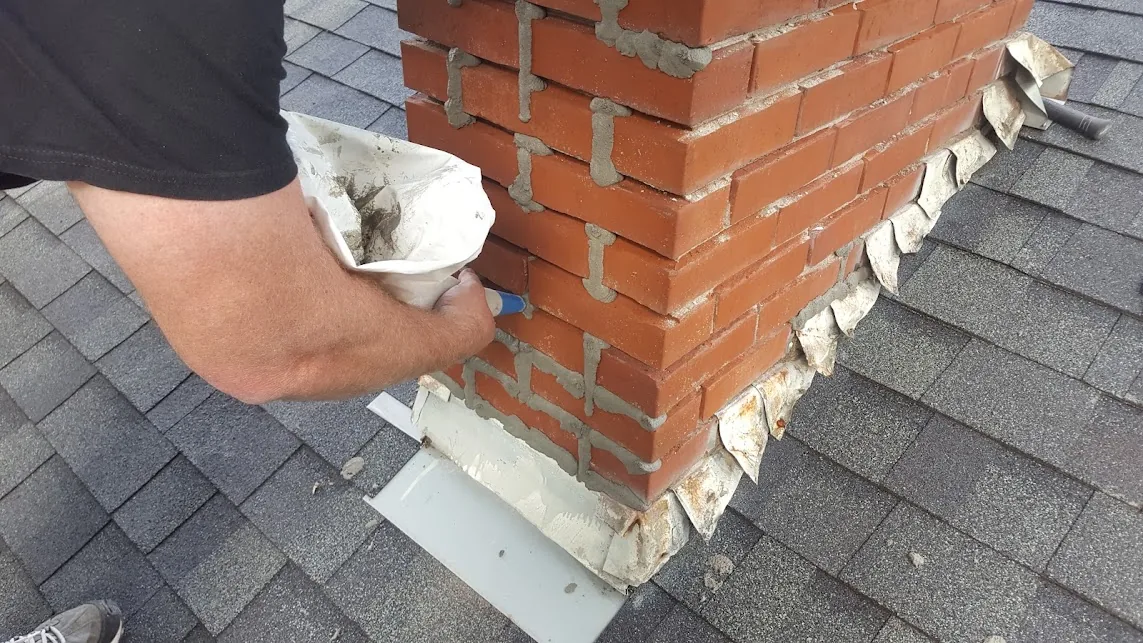
How Much Does Chimney Tuckpointing Cost in Minnesota?
Chimney tuckpointing costs $500 to $2,500 for a typical chimney, according to a published 2026 cost guide. The same guide prices it at $8 to $30 per square foot, or $20 to $50 per row of brick. Two-story or complex chimney stacks run $5,000 to $7,000.
Those are national figures, and the chimney itself sets the price. The guide names size, height, brick condition, mortar damage, roof slope and access as the factors. How we rake out and refill the joints is on our chimney tuckpointing page. Mortar work on the walls of a house is a separate job, priced in our tuckpointing cost guide.
Minnesota is hard on chimney mortar. The guide says moisture, freezing and thawing cause mortar to crack. Minnesota sees 80 to 100 freeze and thaw cycles a year, and a chimney is exposed on all four sides.
What does chimney tuckpointing cost per square foot, per row and per chimney?
| How the job is priced | Published range (2026 national cost guide) |
|---|---|
| Per square foot of chimney | $8 to $30 |
| Per row of brick | $20 to $50 |
| Typical chimney stack | $500 to $2,500 |
| Two-story or complex chimney stack | $5,000 to $7,000 |
The per square foot and per row prices measure the same work two ways. A taller stack has more square feet of brick and more rows. That means more joints to rake out and refill.
Height and hard access push a chimney toward the top of that range, the guide says. For two-story or complex stacks, it gives a separate price of $5,000 to $7,000.
Small jobs cost more per square foot. The guide says small repointing projects cost 10% to 20% more per square foot than large projects. It also notes minimum fees of $200 to $1,500, depending on the type of project. A few open joints on one face can land at the minimum.
What moves the price of chimney tuckpointing?
Height above the roof. The guide says walls and chimneys above 8 feet cost 20% to 40% more to repoint than ground level work. The reason it gives is scaffolding, which adds labor and equipment. A tall stack on a two-story house needs more staging than a short chimney on a rambler.
Roof pitch and access. Roof slope and access are on the guide’s list of price factors. It says blocked or hard-to-reach areas also cost more to repoint. A steep roof takes more setup before any mortar comes out.
How much of the stack has failed. Open joints on one face make a spot repair. Joints failing on every face mean repointing the full stack. The fewer joints that have failed, the smaller the job and the bill.
Labor. Labor is most of the cost. The guide says tuckpointing labor is up to 90% of the total cost. It puts masons at $50 to $125 an hour.
How the joints come out. The guide’s general repointing prices start at $3 to $5 per square foot with an electric grinder. Chiseling smaller joints by hand runs up to $25 per square foot. The National Park Service warns that unskilled use of power tools can be disastrous for soft historic brick.
Why does matching the old mortar change the cost?
Older chimneys need mortar that suits the old brick. The National Park Service covers this in Preservation Brief 2. It says new mortar must be softer than the brick, measured in compressive strength. It must also let water vapor pass through more easily than the brick does.
The same brief sets the depth. Old mortar comes out to at least 2 to 2.5 times the width of the joint. For most brick joints, that is about half an inch to 1 inch deep. Raking every joint to that depth takes time, and the hours show up in the labor cost.
Older homes are common in Minneapolis. In the city, 87,975 of 216,155 housing units were built in 1939 or earlier. That is about 4 in 10, per the Census Bureau’s 2024 American Community Survey.
The cost guide says many homes built before 1930 used natural hydraulic lime mortar and softer bricks. It puts a lab analysis of the old mortar at $300 to $500. That may be required for historic buildings or homes built before 1930.
| Added cost | Published range (2026 national cost guide) | When it comes up |
|---|---|---|
| Mortar composition analysis | $300 to $500 | Historic buildings or homes built before 1930 |
| Mortar color analysis by a lab | $150 to $325 | Some historic or landmark districts |
| Replacing deteriorating bricks | $20 to $30 per square foot | Cracked or spalling brick |
| Minimum job fee | $200 to $1,500 | Small or spot repairs |
Color is usually matched on site. The guide says most masons color-match the mortar at the job site. Homes in historic or landmark districts may be required to get a lab analysis for district approval.
Does brick replacement add to the cost?
It can. The guide says damaged or decaying mortar may weaken the chimney. That can cause other problems that masons discover when tuckpointing.
The guide names the signs that the brick itself needs repair. They are leaks, stair-step cracks along the mortar, loose or cracked bricks and spalling. A few cracked or spalled face bricks can be replaced in the same job. The guide lists replacing deteriorating bricks as its own cost, at $20 to $30 per square foot.
Does the season change the cost in Minnesota?
Winter work costs more. The guide says repointing should be done between late spring and early fall. Mortar needs mild weather for 24 hours before and 72 hours after the work.
Winter repairs are possible with extra steps. The guide says masons cover the wall with heating blankets or tarps, or tarp off the area and heat it. Those measures are usually kept to small projects because of the added labor costs. A chimney that can wait for the season usually costs less to repoint.
What should a chimney tuckpointing estimate include?
A fair price needs a look at the chimney. The guide says most masons require an onsite visit to provide an accurate estimate. A written scope for chimney tuckpointing should name these items:
- Which faces get repointed, or the full stack
- How deep the old mortar comes out
- The mortar type and how it will match the old joints
- How many bricks get replaced, and where
- Scaffolding or roof staging, if the chimney needs it
- Debris cleanup and removal
The guide suggests asking which mortar type the mason will use and why it fits the project. It also says to confirm the quote includes debris cleanup and removal. A scope with these lines makes two bids easy to compare.
When does a chimney need more than tuckpointing?
Repointing fixes the mortar joints. The guide says tuckpointing and repointing are only effective if the damage is limited to the mortar joints. It also says to find and repair the root cause of the damage before repointing. A leak through the crown or flashing has its own costs, covered in our chimney leak repair cost guide.
Some chimneys are past repointing. If repointing cannot fix the damage, the guide puts a rebuild from the roofline up at $1,000 to $3,500. That work is on our chimney rebuilds page.
We price each chimney after a site visit. We photograph every face of the chimney and check how deep the joints have failed. You get one written scope before any work starts.