
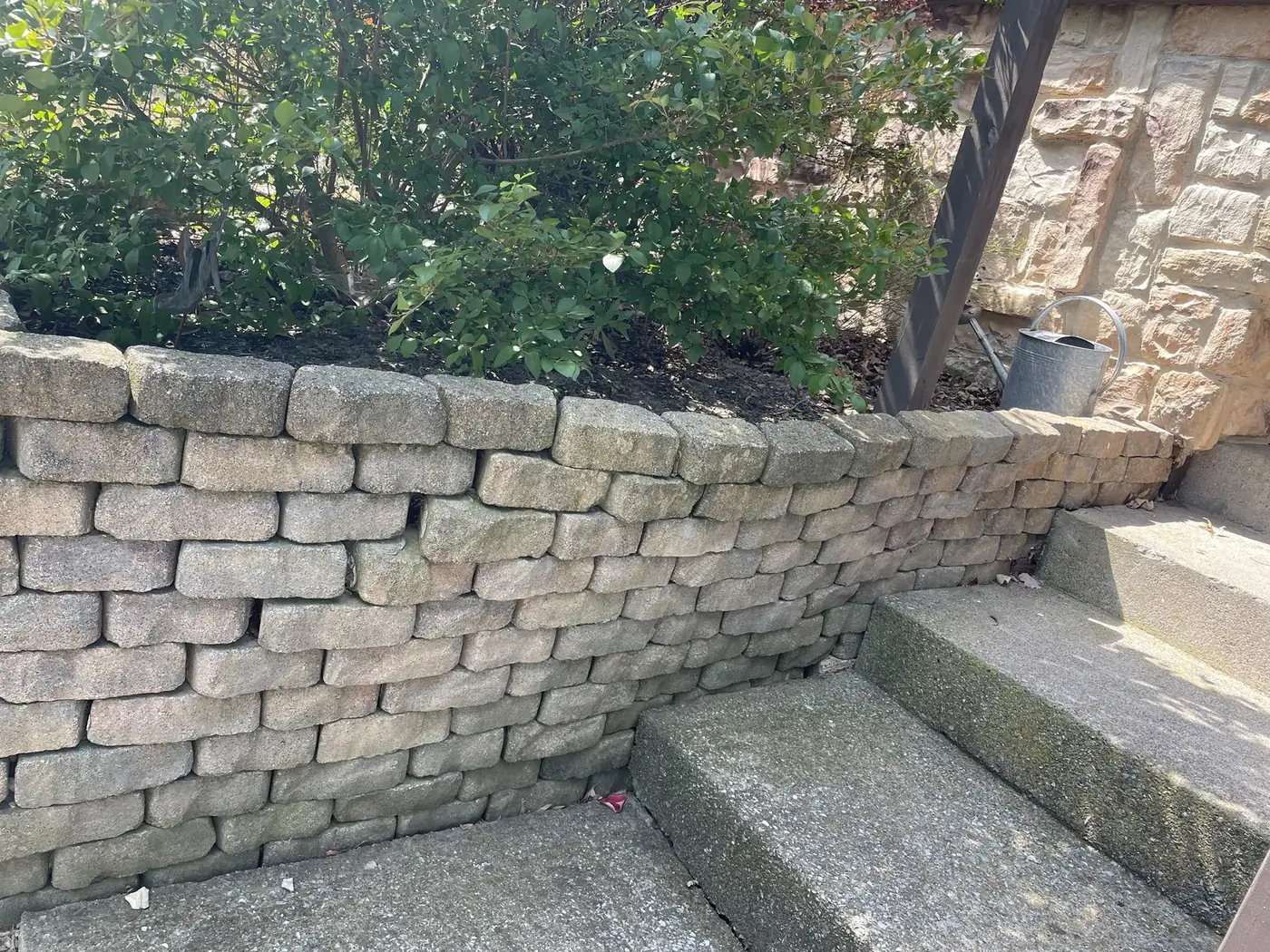
How Much Does Retaining Wall Repair Cost in Minnesota?
A national cost guide puts retaining wall repairs at $100 to $1,500, depending on the wall material and the problem. Removing and rebuilding a 50-foot wall that stands 4 feet tall costs $6,000 to $14,000 in the same guide. Fixing small leaks or cracks typically costs less than repairing a leaning wall, the guide adds.
These figures are for fixing or replacing a wall you already have. Prices for a brand new wall by material and height are in our retaining wall cost guide. Our crew builds and rebuilds block and stone retaining walls across the Twin Cities. The ranges below come from published cost data. Your own price comes from a site visit and a written scope.
What does retaining wall repair cost by problem?
The guide prices five common problems. Its average repair cost for each one is below.
| Problem | What it looks like | National cost guide range |
|---|---|---|
| Leaning or bowing | Excess pressure on one spot makes the wall bulge | $200 to $1,500 |
| Leaking or seeping | Water or soil seeps through cracks or crumbling mortar | $100 to $1,000 |
| Cracking or crumbling | Erosion and weather make the wall crack and crumble | $150 to $1,000 |
| Efflorescence | Salty water dries on the wall and leaves a white residue | $150 to $800 |
| Foundation | Soil pressure shifts the base of the wall over time | $40 to $75 per linear foot |
Ranges from a national cost guide’s table of average repair costs by problem.
The guide also gives an hourly rate. Masons and landscape wall contractors charge $50 to $75 per hour for labor alone, it says. The size of the wall and how easy it is to reach affect labor cost the most.
What do the common fixes cost?
A second table in the guide prices repairs by the method used. Each range below is per square foot, with labor and materials included.
| Fix | What the work involves | National cost guide range per sq ft |
|---|---|---|
| Adding drainage | Drainage pipes or weep holes, which are small holes that let water drain out | $50 to $80 |
| Anchors | Large rods driven through the wall and tied to an anchor that holds it in place | $60 to $80 |
| Reinforcing and straightening | New mortar and concrete, plus a thicker base for the wall | $50 to $80 |
Ranges from a national cost guide’s table of repair costs by solution, labor and materials included.
The guide matches each fix to the problems it treats. It lists anchors for leaning walls and foundation problems. Drainage and reinforcing are listed against all five problems in the first table.
Other line items can show up on a repair estimate. The guide puts steel rebar at $2.50 to $5.00 or more per square foot. Fill dirt for backfill costs $5 to $25 per cubic yard or $150 to $600 per truckload. Material delivery runs $30 to $100 per truckload.
When should you replace part or all of the wall?
Some damage calls for replacement instead of repair. The guide says parts of a wall may need to be replaced, depending on the issue. It puts section replacement at $10 to $150 per square foot, with the material setting where a job lands.
| Wall material | Section replacement per sq ft (national cost guide) |
|---|---|
| Wood or railroad ties | $10 to $40 |
| Stone | $10 to $85 |
| Block | $15 to $55 |
| Metal | $15 to $150 |
| Concrete or cinder block | $20 to $45 |
| Brick | $30 to $60 |
Ranges from a national cost guide’s table of repair costs by material, labor and materials included.
Of the materials in this table, our crew works in block and stone. Freestanding stone walls, which hold back no soil, fall under our stone masonry work.
For a full tear-out, the guide prices a 50-foot wall that stands 4 feet tall.
| Line item | National cost guide range |
|---|---|
| Demolition and removal | $2,000 to $4,000 |
| New wall | $4,000 to $10,000 |
| Total | $6,000 to $14,000 |
Ranges from a national cost guide, labor and materials included, for a wall 50 feet long and 4 feet tall.
By the foot, the guide puts demolition at $10 to $20 per linear foot. Rebuilding runs $40 to $300 per linear foot, depending on the material and height. For that wall, it gives $35 to $65 per square foot for the tear-out and the new wall.
Repair is the cheaper path when it works. The guide calls repairs much more cost-effective and practical than removing a wall and building a new one. It also warns that a small problem left alone can grow and lead to a complete replacement.
Why do retaining walls fail in Minnesota?
The soil behind a retaining wall presses on it. Over time that pressure can shift the wall’s foundation, the guide says. Excess pressure on one spot is what makes a wall lean or bow.
Water plays a part too. A seeping wall lets water or soil through cracks or crumbling mortar. Efflorescence is the white residue left when salty water dries in or on the wall. The guide lists added drainage as a fix for every problem in its table.
Minnesota adds frost. Water in the soil expands about 9 percent as it freezes. Layers of ice that form in the soil can lift it much further. That comes from a 2024 study in the International Journal of Geo-Engineering. Minnesota sees 80 to 100 freeze and thaw cycles a year.
The same study used a computer model of a concrete retaining wall in freezing ground. With drainage material behind the wall, the push from frozen soil on the wall was much lower. The wall also bent and shifted less.
The base under the wall matters too. When soil pressure shifts a wall’s foundation, the guide prices the repair at $40 to $75 per linear foot. Its reinforcing fix includes thickening the base of the wall. Concrete footings, at $18 to $55 per linear foot installed, help strengthen the foundation, it adds.
Do you need a permit to repair a retaining wall in Minnesota?
Minnesota’s building code lists work that does not need a permit. Retaining walls are on that list when they are not over four feet in height. The four feet is measured from the bottom of the footing to the top of the wall. So the footing and any part of the wall below ground count toward the four feet.
The exemption does not apply to a wall that supports a surcharge. That is a code term, so ask your city whether it applies to your wall. An exempt wall still has to follow the rules. The code says exemptions do not authorize work that violates the code or any other local law or ordinance.
Your city’s building department is the place to check. Minnetonka, for example, says construction there is regulated by both the city code and the state building code. Its permit FAQ says a building permit is required for retaining walls more than four feet tall. The guide puts permits for larger repairs or a full replacement at $50 to $450, depending on location.
When does the job need more than the repair priced?
The ranges above price the repair alone. These cases add to the job.
- A wall over four feet. It falls outside the state permit exemption, so plan on a permit before work starts.
- An engineer’s review. The guide suggests hiring a structural engineer before repairing a leaning or bowing wall, to find the underlying cause. It puts structural engineers at $100 to $220 per hour.
- New drainage. If water helped cause the damage, plan on drainage behind the wall as part of the job. The guide prices added drainage at $50 to $80 per square foot.
- Steps through the wall. If steps pass through the damaged section, price them with the wall. Our walkway and step work covers rebuilding them.
Catching problems early keeps the repair small. The guide puts a wall inspection at $150 to $300. It says one should be done every 3 to 5 years.
We look at the wall on a site visit and price the scope in writing.